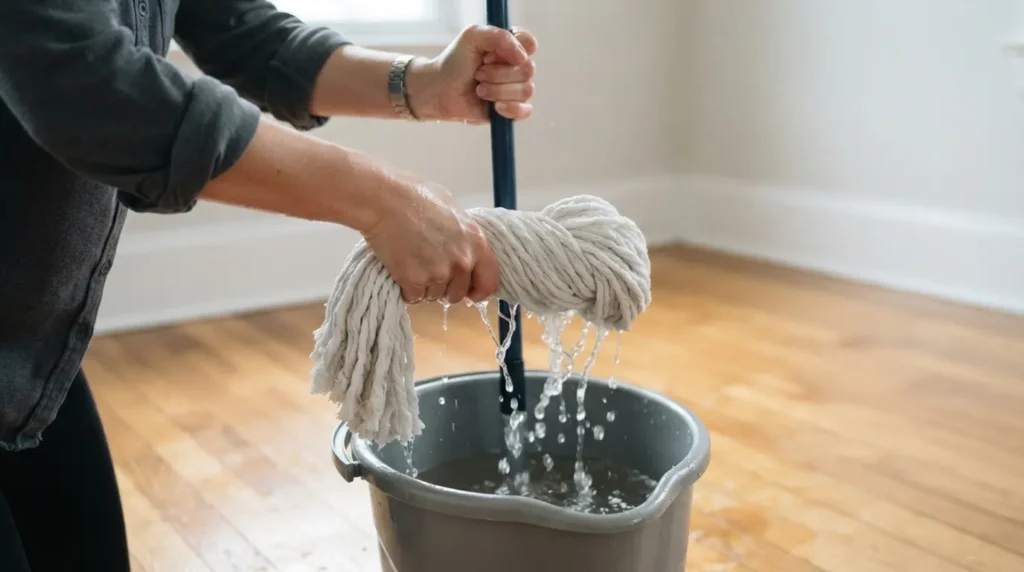
Mopping hardwood floors sounds simple until you realize that water is one of the things wood flooring needs to be protected from.
That does not mean hardwood floors cannot be mopped. It means the amount of moisture, the cleaning product, the mop itself, and the condition of the floor all matter. The National Wood Flooring Association recommends regular damp mopping with a mop that is only slightly moistened and well wrung out, while also emphasizing that homeowners should follow the flooring or finish manufacturer’s cleaning instructions.
If you are wondering how to mop hardwood floors without leaving too much water behind, the answer is less about scrubbing harder and more about controlling moisture.
This guide explains how to mop hardwood flooring safely, what type of mop to use, how much water is appropriate, which mistakes to avoid, and what to do if water has already caused problems.
Can You Mop Hardwood Floors?
Yes, but hardwood floors should not be treated like tile or other surfaces that can tolerate large amounts of water.
The NWFA’s current technical guidance recommends damp mopping wood floors regularly, describing the mop as slightly moistened and well wrung out so that very little moisture remains on the floor. It also recommends using spray mops that give you better control over how much cleaning solution reaches the surface.
At the same time, some manufacturers take an even more restrictive approach.
For example, Bruce recommends spray-and-wipe cleaning rather than mopping with water and specifically tells owners not to use water or steam on its hardwood floors. Shaw likewise advises against wet mops and steam mops and recommends its specified hard-surface cleaner with a dry mop.
So when deciding how to mop hardwood floors, there is one rule that should come before any cleaning recipe:
Follow the maintenance instructions for your particular flooring and finish.
How Much Water Should You Use on Hardwood Floors?
Very little.
Hardwood flooring does not benefit from being saturated. The objective is to loosen and remove surface dirt while leaving as little moisture behind as reasonably possible.
The NWFA recommends a mop that is slightly moistened and well wrung out. It also recommends cleaning spills immediately because standing liquid can damage wood flooring.
Think of the difference between a controlled damp mop and a traditional soaking-wet mop.
A damp mop leaves a small amount of moisture that can be picked up as you clean. A wet mop can leave enough water sitting on the surface or entering joints that the floor remains wet longer than it should.
What Does “Damp” Actually Mean?
A damp mop should feel moist, but it should not be dripping.
If you can squeeze water out of the mop head, it is probably carrying more moisture than you need for routine hardwood maintenance.
If you are using a spray mop, the same principle applies. A light, controlled application is preferable to flooding the floor with cleaning solution.
This is one reason the NWFA recommends spray mops that provide control over the amount of solution applied.
What Type of Mop Is Best for Hardwood Floors?
There is no single mop that is right for every hardwood floor, but a soft microfiber or other non-abrasive mop designed for hard floors is a practical choice for many finished floors.
The important characteristics are:
- A soft, non-abrasive cleaning surface
- Good control over moisture
- A washable or replaceable pad
- The ability to pick up cleaning solution rather than simply spread it around
- Compatibility with the flooring manufacturer’s recommended cleaning method
The NWFA specifically recommends high-quality spray mops with absorbent pads when spray mopping is appropriate.
Bruce recommends a soft-covered swivel-head mop with its hardwood floor cleaner and uses a spray-and-wipe approach rather than water mopping.
How to Mop Hardwood Floors Step by Step
If your flooring manufacturer’s instructions permit damp or controlled mopping, the process can be straightforward.
1. Remove Dirt and Grit First
Do not start by pushing a damp mop across a floor covered with loose dirt.
Sweep, dust mop, or vacuum first.
The NWFA recommends frequent dry sweeping or dust mopping because dirt particles can be abrasive and can become embedded or ground into the finish. It also recommends using a hard-surface vacuum setting rather than a carpet setting with a rotating beater bar.
This first step makes the actual mopping more effective and reduces unnecessary wear.
2. Check the Floor Manufacturer’s Instructions
Before choosing a cleaning solution or mop, identify what type of hardwood floor you have and, if possible, what finish it has.
A factory-finished floor, a site-finished floor, an oiled floor, and a waxed floor can have different maintenance requirements.
The NWFA specifically notes that natural oil and wax finishes require additional precautions and that homeowners should follow flooring or finish manufacturer’s instructions.
3. Choose the Correct Cleaner
Do not assume that a household cleaner is suitable simply because it is gentle on another surface.
Use a cleaner recommended for your particular hardwood flooring or finish.
The NWFA warns that non-recommended cleaning products can affect the appearance of the finish and may even create problems when the floor needs to be recoated.
Bruce similarly advises against products such as ammonia-based cleaners, bleach, detergents, abrasive soaps, acidic substances such as vinegar, and certain wax or oil-based products on its hardwood flooring.
4. Control the Moisture
If your floor permits damp mopping, wring the mop thoroughly before it reaches the floor.
If you use a spray mop, apply only the amount of cleaner needed for the area you are working on.
The goal is not to make the floor visibly wet. The goal is to clean the surface while controlling how much liquid is introduced.
5. Work in Manageable Sections
Rather than wetting the entire room at once, work through smaller sections.
This gives you better control and lets you notice immediately if too much solution has been applied.
If the floor is staying visibly wet, stop and reduce the amount of liquid you are using.
6. Pick Up Excess Moisture
Do not leave puddles, wet patches, or pools of cleaner behind.
If excess moisture remains on the surface, remove it with a clean, dry microfiber pad or cloth as appropriate for your flooring.
Bruce’s care instructions specifically say to dry excess cleaner immediately.
7. Let the Floor Dry
Once you finish, allow the floor to dry naturally.
Avoid walking across a wet floor unnecessarily, and do not put rugs or objects back onto a visibly damp surface.
The faster you can control and remove excess moisture, the less opportunity it has to reach vulnerable areas of the flooring.
Damp Mop vs. Wet Mop: What’s the Difference?
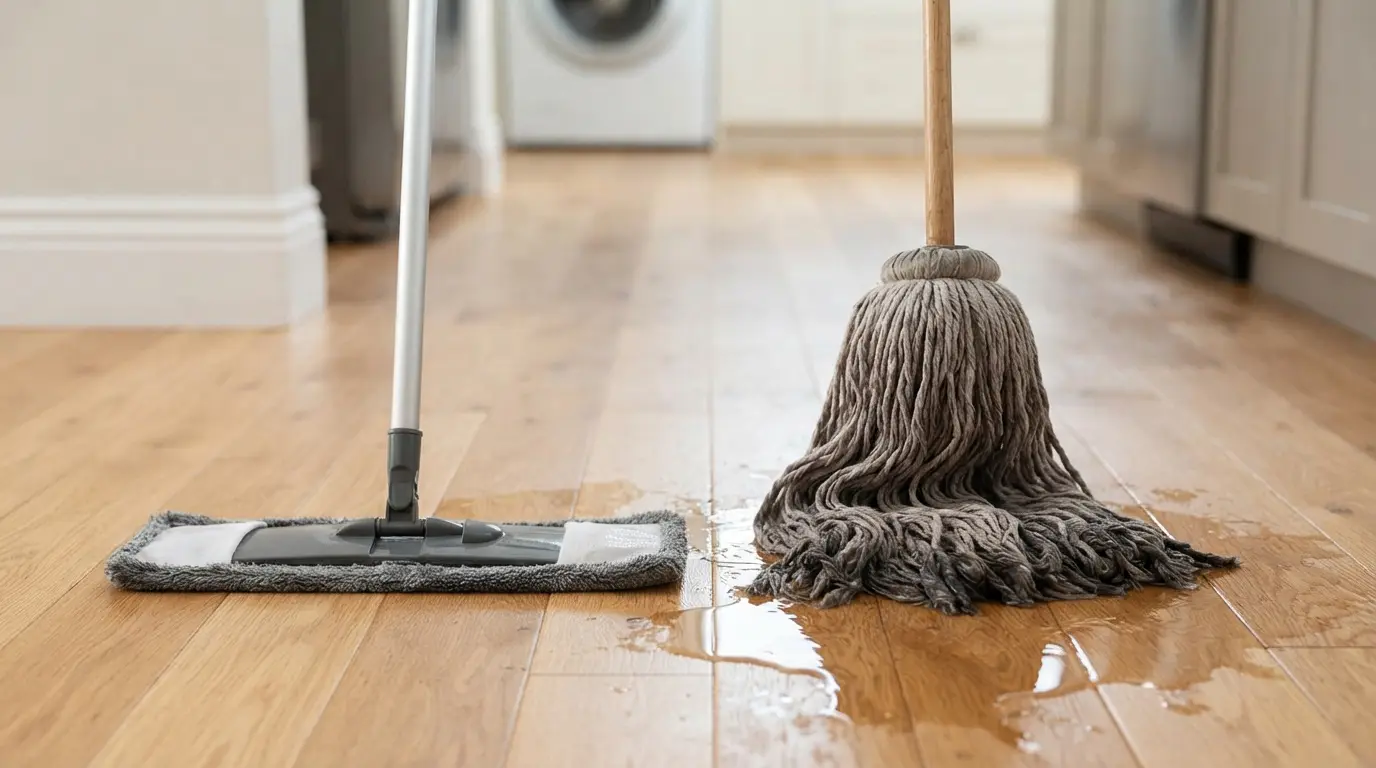
The distinction is important.
| Mopping Method | Moisture Level | Risk to Hardwood | General Guidance |
|---|---|---|---|
| Dry microfiber mop | None | Very low | Useful for routine dust and dirt removal |
| Spray mop with controlled cleaner | Low | Generally low when manufacturer-approved | Provides good control over solution |
| Well-wrung damp mop | Low | Depends on floor and finish | NWFA recommends minimal moisture |
| Wet mop | High | Higher | Avoid unless specifically permitted |
| Soaking or flooding floor | Very high | High | Not appropriate for routine hardwood care |
| Steam mop | Heat plus moisture | High for many hardwood systems | Avoid unless specifically approved |
The table reflects the important distinction between controlled moisture and excessive moisture. It is not a substitute for the care instructions supplied with a particular flooring product. The NWFA, Shaw, and Bruce all emphasize limiting moisture, although their specific cleaning procedures differ.
Can You Use a Wet Mop on Hardwood Floors?
Generally, you should avoid a traditional wet mop that leaves substantial water behind.
Shaw explicitly says not to use wet mops or steam mops on its hardwood flooring. Bruce similarly says not to use water or steam on its hardwood floors and instead recommends a spray-and-wipe cleaning approach.
This is an important distinction from a slightly damp, well-wrung mop.
If your manufacturer’s instructions permit damp mopping, the mop should contain very little water. If the manufacturer says to use a dry mop and a specified cleaner, follow that procedure instead.
Can Too Much Water Damage Hardwood Floors?
Yes.
Wood naturally responds to changes in moisture. Excess water can create problems with both the finish and the wood itself.
The NWFA identifies excessive moisture and standing liquid as potential causes of flooring problems and recommends wiping spills immediately.
Water-related problems can include:
- Swelling
- Cupping
- Crowning
- Warping
- Finish damage
- Discoloration
- Gaps after drying
- Damage around board joints
The exact result depends on the flooring, how much moisture was introduced, how long it remained present, and other environmental conditions.
If you are already seeing raised edges or unusual board movement, continuing to mop the floor will not solve the underlying problem.
You can learn more about these conditions in Floorika’s guide to cupping, crowning, and buckling in hardwood floors.
What Happens When Water Gets Between Hardwood Boards?
Board joints are one reason moisture control matters.
Wood flooring can move naturally as its moisture content changes. When liquid reaches areas between boards, the wood can absorb moisture and respond by swelling.
That does not mean every drop of water that reaches a floor joint will automatically cause damage. Hardwood flooring is designed to handle normal household conditions. The problem comes from excessive or prolonged moisture exposure.
A spill that is wiped up promptly is very different from water sitting on the floor for an extended period.
That is why immediate spill cleanup is one of the simplest ways to reduce moisture-related problems. Both the NWFA and major flooring manufacturers emphasize prompt spill removal.
How Often Should You Mop Hardwood Floors?
There is no universal schedule that applies to every home.
Cleaning frequency depends on foot traffic, pets, children, outdoor dirt, the room, and the manufacturer’s care recommendations.
The NWFA’s current technical guidance says to damp mop floors regularly, giving weekly as its example, while also recommending frequent dry sweeping and immediate spill cleanup.
Shaw’s care routine similarly separates regular dry cleaning from more occasional wet-product cleaning. Its current guidance recommends daily spot cleaning and sweeping or vacuuming, with its recommended cleaner used weekly.
The practical takeaway is simple:
Do not use more moisture just because the floor looks dirty.
Remove loose dirt regularly and use the manufacturer’s approved cleaning method when deeper surface cleaning is necessary.
Should You Mop Hardwood Floors Every Day?
Usually, there is no reason to introduce cleaning solution and moisture every day.
Daily maintenance is better handled through dry methods such as sweeping, dust mopping, or appropriate vacuuming, with spills cleaned immediately.
The NWFA recommends frequent dry sweeping and dust mopping to remove particles before they can contribute to wear.
High-traffic areas may need more frequent attention, but that does not necessarily mean more frequent wet cleaning.
What Should You Put in a Mop for Hardwood Floors?
Use the cleaning product specified or approved by your flooring or finish manufacturer.
This is particularly important because different finishes can have different maintenance requirements.
For example, the NWFA notes that oil-finished and waxed floors require specific maintenance procedures and warns against using products that are inappropriate for those finishes.
Avoid automatically reaching for:
- Vinegar
- Bleach
- Ammonia
- Dish soap
- Abrasive cleaners
- Generic furniture polish
- Unapproved wax
- Strong household detergents
Bruce specifically lists several of these categories among products it does not recommend for its hardwood floors.
If you are unsure what finish is on an older floor, finding that out is more useful than guessing which cleaning recipe to use.
Can You Use a Steam Mop Instead of a Regular Mop?
A steam mop is not a safer substitute for ordinary hardwood-floor cleaning.
The NWFA warns against steam cleaners on wood flooring, and both Shaw and Bruce advise against steam on their hardwood floors. Shaw states that steam cleaning can damage and warp hardwood or laminate flooring.
For more detail on this particular issue, see Floorika’s article on the dos and don’ts of steam cleaning hardwood floors.
Common Mopping Mistakes That Can Damage Hardwood Floors
Knowing how to mop hardwood floors is only half the job. Knowing what not to do is equally important.
Using Too Much Water
A mop should not leave puddles or large wet areas behind.
More water does not necessarily mean better cleaning.
Skipping Dry Cleaning
If you mop before removing loose grit, you can push abrasive particles across the finish.
Sweep or vacuum first.
Using the Same Cleaner You Use on Other Floors
Tile, vinyl, laminate, and hardwood can have different maintenance requirements.
Do not assume that a cleaner designed for one flooring category is appropriate for another.
Leaving Spills to Dry
Even small spills should be dealt with promptly.
Standing liquid is unnecessary exposure for a wood floor.
Using a Steam Mop
Steam introduces both heat and moisture. Major industry and manufacturer guidance advises against steam cleaning many hardwood floors.
Trying to Restore Shine With More Cleaner
A dull floor is not necessarily a dirty floor.
If the finish has worn down, applying more cleaning product will not restore the missing finish.
Floorika has a separate guide explaining why hardwood floors can look dull and when restoration may be appropriate.
How to Mop Different Types of Hardwood Floors
The construction and finish of your flooring can affect its maintenance requirements.
Solid Hardwood
Solid hardwood is made from a single piece of wood, but that does not make it waterproof.
Floorika’s solid hardwood flooring information notes that changes in moisture can cause wood to expand or contract, while regular cleaning and prompt spill removal help protect the floor.
Engineered Hardwood
Engineered hardwood has a real wood surface over a multi-layer core. Its construction provides greater dimensional stability than solid hardwood under changing moisture conditions, but it is still not a floor that should automatically be treated as waterproof.
Shaw describes engineered hardwood as more stable than solid hardwood against moisture and temperature changes, while still distinguishing it from flooring that can simply be exposed to large amounts of water.
If you have engineered hardwood, use the manufacturer’s specific cleaning instructions rather than assuming it can tolerate more water.
Oiled Hardwood
Oiled floors deserve particular attention.
The NWFA states that natural oil finishes require additional precautions and that different oil finishes can have their own maintenance programs.
Do not apply a standard hardwood cleaner to an oil-finished floor without confirming compatibility.
Waxed Hardwood
Waxed floors have their own maintenance requirements as well.
The NWFA advises that water-based cleaners should not be used on waxed floors because they can cause water spots.
If you are unsure whether an older floor is waxed, identify the finish before choosing a cleaning product.
What If You Accidentally Spill a Lot of Water?
Act quickly.
Remove the standing water with absorbent towels or an appropriate dry material. Do not leave the area wet while you decide what to do next.
Then monitor the flooring for changes.
Watch for:
- Swelling
- Cupping
- Board movement
- Discoloration
- Finish changes
- Persistent dampness
- Gaps that appear after drying
The NWFA identifies water damage as a significant cause of wood flooring problems and emphasizes prompt removal of spills.
If substantial water has entered the flooring system, especially from a plumbing leak, appliance failure, or flooding event, the issue is no longer ordinary floor cleaning.
What If Your Hardwood Floor Is Already Showing Water Damage?
Do not try to correct a moisture-related flooring problem by repeatedly cleaning the surface.
The first step is to identify where the moisture came from and make sure the source has been addressed.
After that, the condition of the floor needs to be assessed.
Minor surface issues may be treatable, while significant swelling, buckling, or damaged boards can require professional repair or replacement.
Floorika offers hardwood floor repair as well as sanding and refinishing services. Its existing guidance on water damage to hardwood floors provides additional information about the issue.
When Cleaning Is No Longer the Real Problem
Sometimes homeowners keep changing cleaning products because the floor does not look the way they want it to.
That can be a mistake.
A floor that is dirty can often be cleaned.
A floor with a worn finish, deep scratches, water damage, or damaged boards needs a different solution.
For example, the NWFA explains that scratches limited to the finish may be addressed with maintenance coating, while deeper scratches can require sanding and refinishing.
This is an important distinction because aggressive cleaning cannot replace a damaged finish.
If your floor has reached that point, Floorika’s hardwood floor refinishing guide explains what to expect from the refinishing process.
Frequently Asked Questions
How often should you mop hardwood floors?
Cleaning frequency depends on traffic and the manufacturer’s instructions. The NWFA gives weekly damp mopping as a general example while recommending frequent dry cleaning and immediate spill removal.
What is the best way to mop hardwood floors?
Use the cleaning method specified by the flooring or finish manufacturer. Where damp mopping is permitted, use a slightly moistened, well-wrung mop and leave as little moisture on the surface as possible.
How much water is safe for hardwood floors?
There is no universal volume that applies to every floor. The goal is to use the minimum moisture required by the manufacturer’s approved cleaning method and avoid standing water.
Can I use a wet mop on hardwood floors?
Many manufacturers advise against wet mopping. Shaw and Bruce specifically recommend against wet mops on their hardwood flooring.
Can I use a microfiber mop on hardwood floors?
A soft microfiber mop can be suitable when used according to the flooring manufacturer’s instructions. The important factors are the mop’s abrasiveness and the amount of moisture it leaves behind.
Can I use a spray mop on hardwood floors?
A spray mop can provide good control over moisture. The NWFA specifically recommends high-quality spray mops with absorbent pads when spray mopping is appropriate for the floor.
Should I dry my hardwood floor after mopping?
If excess moisture remains, remove it rather than allowing water to sit on the surface. Some manufacturers, such as Bruce, specifically instruct users to dry excess cleaner immediately.
Is damp mopping safe for engineered hardwood?
It depends on the product and finish. Engineered hardwood is not automatically waterproof, so follow the specific manufacturer’s maintenance instructions.
Can mopping cause hardwood floors to buckle?
Excessive or prolonged moisture can contribute to movement and damage, including buckling. If boards have already started moving or rising, investigate the moisture source rather than continuing to mop.
Can you mop hardwood floors with just water?
Do not assume that plain water is the safest option. Some manufacturers specifically advise against water mopping and instead recommend a compatible cleaning product used with a controlled spray-and-wipe method.
The Right Way to Mop Hardwood Floors Is About Moisture Control
Learning how to mop hardwood floors is less about finding the strongest cleaner and more about understanding what your floor can tolerate.
Start with dry cleaning to remove grit. Follow the manufacturer’s instructions for the flooring and finish. If damp mopping is permitted, use a slightly moistened and well-wrung mop rather than soaking the surface. If your manufacturer specifies a spray-and-wipe system, use that instead.
And remember that more water does not equal a cleaner floor.
The NWFA recommends minimizing moisture, removing spills promptly, and using cleaning products appropriate for the flooring and finish. Shaw and Bruce take similarly cautious approaches in their own hardwood care instructions.
For the bigger picture, you can return to the complete guide to how to clean hardwood floors for routine care, cleaning methods, and maintenance guidance.
When Your Hardwood Floor Needs More Than Mopping, Choose Floorika Fine Hardwood
Sometimes the best thing you can do for a hardwood floor is stop trying to clean the problem away.
If the floor has deep scratches, worn finish, water-related damage, damaged boards, or other issues that routine maintenance cannot address, professional flooring work may be the appropriate next step.
Floorika Fine Hardwood provides hardwood floor installation, sanding, refinishing, and repair, rather than residential cleaning services. Its team works with hardwood and parquet flooring and also handles restoration projects.
If your floor simply needs routine maintenance, the manufacturer’s recommended cleaning process should remain your first choice. But when the condition of the flooring itself has become the issue, Floorika can help determine whether sanding, refinishing, repair, or another flooring solution makes sense for the project.